
Latest release of Australian Foreign Affairs explores the prospect of countries in Asia developing nuclear bombs
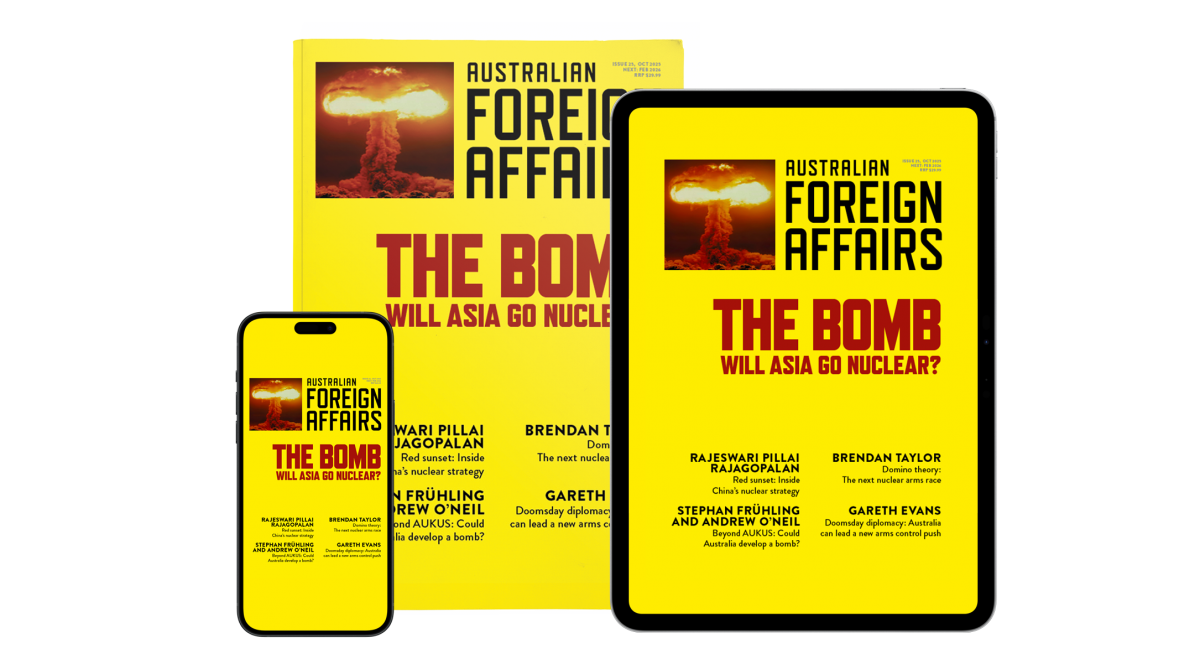
The latest issue of Australian Foreign Affairs is out today.
“The Bomb: Will Asia go nuclear?” explores the prospect of countries in Asia starting to develop nuclear weapons as the region’s changing balance of power poses new questions about their future security.
As anxieties grow about the reliability of the United States as a partner, The Bomb looks at the possibility of a nuclear arms race breaking out in Asia that would likely start with South Korea, and then Japan, and would leave countries such as Australia contemplating previously unthinkable options.
Essays in the latest issue include:
“Red sunset: Inside China's nuclear strategy”, by Rajeswari Pillai Rajagopalan
“Australia has not actively contemplated developing its own nuclear deterrent in decades, but a new debate has now begun, driven by China’s military and nuclear expansion. Another motivating factor are concerns about whether the United States under President Trump can be depended on to protect Australia with its extended deterrence.”
“Domino theory: The next nuclear arms”, by Brendan Taylor
“What if the next countries to acquire the world’s most destructive weapons aren’t our enemies but our friends? This is the unsettling possibility that now confronts Australia. We are entering a new nuclear age, one that looks very different from the Cold War… In Seoul, in Tokyo and perhaps one day in Jakarta, the idea of building independent nuclear forces is no longer unthinkable. These are not hostile states bent on aggression. They are democratic partners with whom we share deep economic and security ties. But if they go nuclear, it will challenge longstanding assumptions, unsettle our alliances and force Australia to confront choices we’ve long preferred to avoid.”
“Beyond AUKUS: Could Australia develop a bomb?”, by Stephan Frühling and Andrew O'Neil
“The popular “domino theory” is unconvincing. North Korea, Iran, Iraq, Syria and Libya sought the bomb because of their relative conventional weakness, not nuclear threats… It is more likely that attempts by an unrestrained Moscow or Beijing to impose their hegemony on Eurasia would lead countries with similar outlooks to react in a similar way. The question then is: if Japan or South Korea seek their own bomb, would Australia necessarily take the same step?”
“Doomsday diplomacy: Australia can lead a new arms control push”, by Gareth Evans
“Nuclear arms control has never been more necessary, and never more difficult to achieve. In all three of its dimensions – risk reduction, non-proliferation and outright elimination – the outlook ranges from desolate to hopeless. The important arms control agreements of the past are dead, dying or on life support. And the recent behaviour of the actors that matter most – the United States, Russia and China – has fed concerns that things can only get worse.”
About Australian Foreign Affairs
Australian Foreign Affairs is the country’s leading foreign affairs journal. It makes foreign affairs accessible to a wide readership.
Contributors have included Penny Wong, Malcolm Turnbull, Hugh White, Sam Roggeveen, Emma Shortis and more.
Australian Foreign Affairs has three issues a year, published in February, July and October.
Australian Foreign Affairs also publishes Foreign Exchange, a new YouTube series with Sam Roggeveen and
Hugh White that provides expert insights into Australia’s future in a changing world. Videos are released fortnightly on a Thursday.
Contact
If you would like to book an interview with the editor, Jonathan Pearlman, or any of The Bomb’s contributors please contact:
Monica Zen
[email protected]